
High School Athlete Evolution to Market-Based System:
How the NCAA’s Amateurism Defense Collapsed and What Replaced It
The Argument That Held the Line — Until It Didn’t
There was a sentence the NCAA repeated so many times, in so many courtrooms, in so many congressional testimonies, that it began to sound less like a legal position and more like a prayer: the high school athlete and college athletics is different.
Different from the NFL. Different from the NBA. Different from any commercial enterprise subject to antitrust law or labor regulation. The athletes, the argument went, were students first — young people whose participation in sport was an extension of their academic journey, not a job.
The scholarship — tuition, room, board, books — was not a wage. It was an educational opportunity. To pay them anything more would be too corrupt the purity of the enterprise, to collapse the distinction between college and professional sport, to destroy the thing that made Saturday afternoons in packed stadiums feel meaningful.
For roughly a century, that argument worked.
It worked because courts deferred to the NCAA’s self-described educational mission. It worked because the college and high school athlete themselves — mostly 18-to-22-year-olds from working-class and middle-class backgrounds — lacked the legal standing, financial resources, and institutional support to challenge it. And it worked because the revenue at stake, while growing, had not yet reached the scale that makes exploitation impossible to ignore.
That scale arrived. And with it, the lawsuits. And with the lawsuits, the reckoning.
Today, that argument no longer holds in any federal court of consequence. What has replaced it is a market-based system — imperfect, still evolving, occasionally chaotic — in which athlete compensation is increasingly determined by economic forces: booster funding, conference revenue, recruiting competition, and now formal revenue sharing, rather than by NCAA rules designed, however the organization described them, to preserve institutional profit margins.
Understanding how we got here requires tracing a story that begins not in a boardroom or a courtroom, but on a high school football field.
High School Athlete Evolution
The Legal Architecture of Amateurism — and Its Structural Weakness
To understand why the NCAA’s legal position eventually collapsed, you need to understand what it was actually built on.
The NCAA is, at its core, a trade association: a collection of member institutions that agree to common rules governing athletic competition, recruiting, and — critically — athlete compensation. When hundreds of competing institutions collectively agree to pay athletes nothing beyond a scholarship, that is, by any plain economic reading, price-fixing. A cartel agreement to suppress wages.
The NCAA’s defense against this characterization was creative and, for decades, effective. In Board of Regents v. NCAA (1984), the Supreme Court acknowledged that the NCAA’s rules produced “some restraints on competition” but suggested that certain limits were necessary to preserve the “revered tradition of amateurism.” This dicta — observations by the Court that were not technically binding — became the legal foundation the NCAA cited for the next four decades to insulate its compensation rules from antitrust challenge.
The flaw in that foundation was always visible to careful readers. The Board of Regents Court was ruling on television broadcast rights, not athlete compensation. Its remarks about amateurism were contextual, not doctrinal. The NCAA, however, treated them as a constitutional shield. For years, lower courts went along.
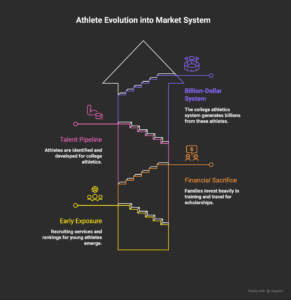
High School Athlete Evolution
O’Bannon v. NCAA: The First Crack
High School Athlete Evolution Into Legal Combatants: The Market-Based System Gets Its First Test in Court
Ed O’Bannon was not a high school athlete when he filed his lawsuit. He was a former UCLA basketball player who, in 2009, saw his likeness being used in an EA Sports video game — without his consent and without any compensation reaching him.
The lawsuit he filed, O’Bannon v. NCAA, was the first major antitrust challenge to the NCAA’s compensation rules to gain serious traction in federal court. The Northern District of California’s Judge Claudia Wilken ruled in 2014 that the NCAA’s restrictions on athlete compensation constituted an unlawful restraint of trade. The Ninth Circuit upheld the core finding: the NCAA is not exempt from antitrust law.
The remedy was narrow — schools could offer athletes up to $5,000 annually in deferred compensation, held in trust until after graduation — and the Ninth Circuit ultimately struck even this down as going too far. But the doctrinal shift was permanent. Courts had officially rejected the idea that the NCAA’s amateurism rules deserved automatic deference.
O’Bannon told the NCAA something it had not heard before: you will have to justify your rules on competitive grounds, like everyone else.
High School Athlete Evolution
NCAA v. Alston: The Ruling That Changed Everything
If O’Bannon was the crack, Alston was the wall coming down.
NCAA v. Alston, decided unanimously by the United States Supreme Court on June 21, 2021, arose from another class-action antitrust challenge to NCAA compensation rules — this one focused specifically on education-related benefits: graduate school scholarships, paid internships, computers, and science equipment.
Writing for a unanimous Court, Justice Neil Gorsuch applied the “rule of reason” test that governs antitrust analysis and found that the NCAA’s restrictions on education-related benefits served no legitimate procompetitive purpose that could not be achieved through less restrictive means. The NCAA lost, 9-0.
But the case’s most lasting impact came not from the majority opinion but from Justice Brett Kavanaugh’s concurrence — a document that reads less like a judicial opinion than a warning shot:
“Traditions alone cannot justify the NCAA’s decision to build a massive money-raising enterprise on the backs of student athletes who are not fairly compensated.”
Kavanaugh went further, writing that the NCAA’s broader compensation restrictions — not just the education-related rules at issue in Alston, but the entire framework — appeared to be “price-fixing labor” and would “raise serious questions under the antitrust laws.”
This was not a holding. It was a signal. And every plaintiff’s attorney in the country read it the same way: the Supreme Court had just told them to keep going.
High School Athlete Evolution
NIL: The Market Rushes In
The High School Athlete Evolution Reaches the Open Market: NIL and the Market-Based System Take Hold
The NCAA’s response to Alston was reactive and incomplete. On July 1, 2021 — one day before the ruling’s effective date — the organization suspended its prohibition on athletes profiting from their name, image, and likeness. Athletes could now sign endorsement deals, monetize social media platforms, charge for autographs and appearances, and operate businesses under their own names.
What followed was not the orderly, modest expansion the NCAA had envisioned. It was a gold rush.
Within months, top football and basketball recruits were signing NIL agreements worth hundreds of thousands of dollars. By 2022, the most marketable athletes — quarterbacks, point guards, gymnasts with large social followings — were earning seven figures annually. Simultaneously, a new institutional form emerged: the NIL collective.
Collectives are third-party organizations, funded by boosters and alumni, specifically designed to pool money and direct it toward athletes at a particular school. They are, in practice, what pay-for-play looks like when it has been re-engineered to comply with the letter, if not the spirit, of the rules. A recruit signs with a school; a collective funded by that school’s boosters then signs the recruit to a generous “NIL deal.” Everyone pretends this is not a wage. Everyone knows it is.
For the high school athlete navigating this landscape, the transformation has been disorienting and consequential. Elite recruits now receive NIL valuations before they enroll. Their decisions about where to attend college are shaped not only by coaching staff, campus culture, and academic programs, but by the size of the collective’s war chest and the dollar figure attached to their commitment.
The high school athlete evolution into a market participant, in other words, is now essentially complete — and it is happening years before these young people ever play a college game.

High School Athlete Evolution
House v. NCAA: Revenue Sharing Becomes Reality
The Market-Based System for the High School Athlete Evolution Is Formalized: The House Settlement
The final and most structurally transformative development arrived through House v. NCAA, a class-action lawsuit that targeted not just future compensation rights but past damages — money the NCAA had wrongfully withheld from athletes dating back to 2016.
In May 2024, a landmark $2.8 billion settlement was reached. The agreement did two things that will define college athletics for the foreseeable future.
First, it provided roughly 14,500 current and former college athletes with back-pay damages for NIL earnings they were denied under the old rules. These are not symbolic amounts. Individual settlements for former top-tier football and basketball players run into the six figures.
Second, and more consequentially, the settlement established a direct revenue-sharing framework beginning with the 2025–2026 academic year. Schools participating in the settlement — the overwhelming majority of Power Four programs — will be permitted to share revenue directly with their athletes, up to an initial annual cap of approximately $20–22 million per school, structured to increase each year.
This is not a scholarship. It is not an NIL deal routed through a collective. It is a university writing a check — a portion of the billions generated by broadcast contracts, ticket sales, and sponsorship agreements — to the athletes who make those revenues possible.
The era of unpaid college athletics is over. The era of formalized, market-structured athlete compensation has begun.
High School Athlete Evolution
What Was Actually Being Protected — and Who Is Still Being Left Behind
It is worth pausing to name clearly what the NCAA’s amateurism framework was actually protecting, because the organization’s stated justification — the “collegiate model,” the “educational mission,” the “student-athlete experience” — was never an accurate description of the underlying economics.
What was being protected was institutional profit.
Universities were capturing the full value of athlete labor while remitting to the athletes a scholarship whose cost, for a flagship state school, might represent 20 to 30 cents on the dollar compared to what those athletes generated. Athletic directors earned $1 million to $4 million annually. Head football coaches at elite programs signed contracts worth $10 million per year. The athletes who made Saturday game days possible earned room, board, and tuition — and were told to be grateful.
The new system is more honest about the economics. It is also, however, far from equitable.
The revenue-sharing framework flows almost entirely to high school athletes in revenue-generating sports: primarily football and men’s basketball. The gymnast, the cross-country runner, the softball player — their sports exist in most athletic department budgets as cost centers, not revenue sources. As schools scramble to fund the $20-million-plus revenue-sharing obligation, non-revenue sports face cuts. Walk-on rosters are shrinking. Olympic sport programs are being discontinued at schools that cannot afford both revenue sharing and broad-based athletic participation.
The high school athlete evolving into this market-based system must now calculate not only whether they can earn a scholarship, but whether the sport they have trained in since childhood will still exist by the time they enroll.
High School Athlete Evolution
The Transfer Portal and the End of Institutional Control Over Athletes
Alongside compensation, the NCAA’s ability to restrict athlete movement has collapsed with equal thoroughness.
For most of college athletics history, transferring schools meant sitting out a full year of competition — a punitive rule that functioned less as a protection of athlete welfare and more as a mechanism for coaches and programs to retain athletes who might otherwise leave. The athlete was bound to the institution in ways the institution was never bound to the athlete: coaches departed mid-season for better jobs; scholarships could be non-renewed; athletes had little recourse.
The one-time transfer exception, introduced in 2021, eliminated the sit-out rule for a single transfer. By 2024, under continued legal and political pressure, the NCAA moved toward a model of essentially free movement — athletes may transfer with immediate eligibility, subject only to overall eligibility limits.
The transfer portal now processes thousands of athletes each year. A starting quarterback unhappy with his role, a five-star recruit who wants to pursue a better NIL deal, a junior point guard drawn to a school with a deeper collective — all can move with a freedom that would have been unimaginable a decade ago.
For the high school athlete evolution into this market-based system, the transfer portal has complicated the already fraught calculus of the college decision. A commitment to a school is no longer a four-year contract. It is the opening position in an ongoing negotiation.

High School Athlete Evolution
The Old Order Did Not Evolve — It Was Dismantled
The framing that the NCAA “adapted” to changing times is, on the evidence, false. The organization resisted every significant reform — NIL, the transfer portal, revenue sharing — until federal courts made resistance legally untenable. It litigated O’Bannon through appeals. It litigated Alston to the Supreme Court. It settled House only after losing on the merits at every stage.
This is not evolution. It is a series of defeats followed by compelled concessions.
What has replaced the old system is genuinely new: a market-based framework in which the value of athletic labor is increasingly reflected in athlete compensation, where recruiting competition drives up the price paid to elite high school prospects, and where conference revenue — not NCAA rules — sets the effective ceiling on what athletes can earn.
It is a better system than the one it replaced. It is also a system that concentrates its benefits at the top: the elite programs, the Power Four conferences, the high school athletes in the two sports that generate the overwhelming majority of college athletics revenue. The walk-on swimmer. The Division II volleyball player. The high school athlete who trained for a decade to compete at the college level in a non-revenue sport — these participants are, in many cases, worse off in a world where athletic department resources are increasingly redirected toward revenue-sharing obligations.
The market, in other words, has arrived in college athletics with all the clarity and all the cruelty that markets typically deliver. It rewards what generates revenue. It is indifferent to everything else.
High School Athlete Evolution
What Comes Next for the High School Athlete in a Market-Based System
The questions that will define the next decade of college athletics policy are no longer about whether athletes will be compensated. They are about how, by whom, under what structure, and with what protections.
The National Labor Relations Board has actively pursued a determination that college athletes at private universities are employees — a finding that would trigger collective bargaining rights, union representation, and a fundamentally different legal relationship between athlete and institution. Federal courts are still working through the employment question. Congress has been asked, repeatedly, to pass legislation that would create a uniform national framework for NIL and revenue sharing; it has not yet done so.
Meanwhile, the high school athlete entering this market must navigate a landscape that is simultaneously more lucrative and more complex than anything previous generations faced. The decision about which college to attend is now also a decision about which NIL market to enter, which collective has the deepest funding, which conference generates the most broadcast revenue, and which program’s roster construction offers the best path to professional sports visibility.
These are not questions that 17-year-olds should bear alone. Many of them do.
High School Athlete Evolution
Conclusion: The Earned Reckoning
The story of college athletics over the past decade is not, ultimately, a story about NIL deals or transfer portals or billion-dollar lawsuits. It is a story about what happens when an institution’s self-serving mythology finally runs out of willing believers.
The NCAA told a story about amateurism and education and the purity of the collegiate model. It told that story for one hundred years. It told it in court, and in Congress, and in press releases, and at press conferences after landmark legal defeats. It told it, in the end, to a Supreme Court that read the record, looked at the revenues, looked at the coaches’ salaries, looked at the broadcast contracts, and voted nine to zero that the story was not true.
What has replaced it is a market-based system — imperfect, evolving, sometimes chaotic, often inequitable. It is not a clean resolution. But it is, at least, an honest one. The high school athlete evolution into that market-based system represents neither a triumph nor a tragedy. It represents the slow, contested, litigated arrival of economic reality into a domain that had, for too long, been allowed to pretend it operated outside the laws that govern every other form of American commerce.
The argument that college athletics was different no longer holds in any federal court of consequence. It never really did.
Have more questions. Schedule a FREE 30 minute consultation with one of our college recruiting coordinators.
Click the image below….