
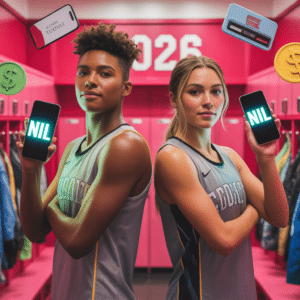
NIL and High School Athletes in 2026 | Over $1.67 billion in NIL deals have been signed since the NCAA opened the floodgates in 2021 — and now, high school athletes are stepping into the spotlight.
The game has changed. If you’re a high school athlete, your name, image, and likeness have real monetary value right now, not just when you get to college.
But navigating NIL as a teen athlete? It can feel overwhelming. Which states allow it? How do you land a deal? What do your parents and coaches need to know?
We’ve got you covered. This is a comprehensive guide to NIL and high school athletes 2026.
NIL and High School Athletes 2026
What Is NIL and Why Does It Matter for High School Athletes?
NIL stands for Name, Image, and Likeness — the legal right for athletes to profit from their personal brand, turning athletic talent and public presence into legitimate income streams.
Originally, NIL rules only applied to college athletes following the NCAA’s landmark 2021 policy change, which ended decades of restrictions that prevented student-athletes from earning money from their own identity. Since then, dozens of states have passed legislation extending NIL rights to high school students, recognizing that young athletes deserve the same economic opportunities as their college counterparts.
NIL and High School Athletes 2026
High School Athletes can now legally sign endorsement deals, post sponsored content, run skills camps, sell personal merchandise, and monetize their social media platforms — all while still competing in high school sports. The earlier an athlete begins building their brand, the stronger and more marketable their NIL portfolio becomes by the time college recruitment conversations begin, giving them a measurable edge over peers who wait.
NIL income can also help families offset the enormous and often underappreciated costs of elite youth athletics — including travel fees, premium equipment, private coaching, recruiting services, and showcase event registrations. For many middle-class families, NIL earnings aren’t just a bonus — they’re a genuine financial relief that keeps talented athletes in competitive programs.
NIL and High School Athletes 2026
NIL and High School Athletes 2026
Which States Allow NIL and High School Athletes in 2026?
State law governs NIL and High School Athletes 2026 entirely, and the legislative landscape has expanded significantly over the past several years, making it more important than ever for athletes and families to understand exactly where their state stands.
As of 2026, over 40+ states have enacted some form of NIL and High School Athletes 2026 legislation, with more states actively considering bills that would bring them into compliance with the growing national standard. States like California, Texas, Florida, Georgia, and Illinois are among the most permissive, offering relatively broad frameworks that allow athletes to pursue a wide range of commercial opportunities without jeopardizing their eligibility.
NIL and High School Athletes 2026
Some states require formal school or state athletic association approval before any deal is signed, meaning athletes must submit contracts or disclosure forms to an administrator before the agreement takes effect. A handful of states still prohibit or heavily restrict NIL activity at the high school level, reflecting ongoing debates about the appropriate age at which commercial exploitation of athletic identity should begin.
Athletes must thoroughly verify their state’s specific rules through their state athletic association — typically an NFHS member organization — before pursuing any deal, no matter how small or seemingly harmless. Violations of state-specific NIL rules can directly affect an athlete’s amateur status and competitive eligibility, potentially resulting in suspension, forfeiture of games, or disqualification from postseason play — consequences no athlete or family wants to face.
NIL and High School Athletes 2026
Types of NIL Deals Available to High School Athletes
NIL isn’t just for five-star recruits or nationally ranked prospects — meaningful opportunities exist at every level of high school athletics, from nationally televised stars to standout players in local markets.
Social media sponsorships are among the most accessible NIL opportunities, where brands pay athletes to create and publish content on platforms like Instagram, TikTok, or YouTube, typically in exchange for promoting a product, service, or campaign to the athlete’s audience. Local business endorsements are equally valuable and often overlooked — gyms, sports retailers, restaurants, orthodontists, and other community-facing businesses actively seek authentic partnerships with hometown athletes who carry local credibility and name recognition.
Personal appearance fees represent another growing category, where athletes are compensated for attending signing events, speaking at youth clinics, participating in charity functions, or making branded community appearances that benefit both the athlete and the hosting organization. Athletes with an entrepreneurial mindset can create and sell personal merchandise and apparel — including custom jerseys, trading cards, signed photographs, or branded training gear — directly to fans and followers through platforms like Shopify or Fanatics.
NIL and High School Athletes 2026
High school athletes who excel in their sport can charge admission or registration fees for camps and training sessions, where younger athletes pay to learn directly from a skilled upperclassman or regionally recognized player. Podcast or content creation represents a longer-term but increasingly lucrative NIL avenue, where athletes build monetized YouTube channels, Twitch streams, or podcast audiences centered on their sport, training lifestyle, or personal story.
Finally, autograph signings — particularly relevant for highly recruited athletes or players with strong regional profiles — can generate meaningful income through organized events or online platforms like Locker or Collectable.
NIL and High School Athletes 2026
NIL Compliance and Eligibility: What Every High School Athlete Must Know – One poorly structured deal — or even a single piece of non-compliant sponsored content — can cost you your season, your eligibility, or your amateur status, which is why compliance must always come before compensation.
Always consult your state athletic association’s official NIL guidelines and speak directly with your school’s athletic director before signing or agreeing to anything, even informally over social media DMs or verbal agreements. Most states explicitly prohibit the use of school logos, team uniforms, school facilities, or references to your specific school in NIL content, meaning athletes must create brand content entirely in personal settings and personal gear to avoid association with their institution.
Athletes generally cannot be compensated simply for being enrolled at or recruited by a specific school — that crosses the well-established line from NIL into pay-for-play territory, which remains prohibited and can trigger serious eligibility consequences at both the high school and future college levels. Disclose all active deals to your school’s athletic director in writing whenever required by state policy, and maintain a personal record of every agreement even in states where disclosure is optional, as documentation protects you if questions arise later.
Keep detailed personal records of all contracts, payment receipts, content deliverables, and posting dates, organized in a digital folder that you can reference quickly if your eligibility is ever challenged by a state association or opposing school.
Every contract, no matter how small or informal it appears, should be reviewed by a qualified sports attorney or certified NIL advisor before you sign, because boilerplate agreements often contain clauses around exclusivity, content ownership, or liability that could limit your future opportunities.
NIL and High School Athletes 2026
The Role of Parents and Coaches in High School NIL
NIL and High School Athletes 2026 is a family endeavor at the high school level, and athletes who have engaged, informed parents and thoughtful coaches behind them are far better positioned to navigate the commercial landscape safely and successfully.
Parents must be actively involved in every stage of contract negotiation and deal evaluation — not just as a legal necessity, since minors cannot execute binding contracts in most states, but as a protective filter that shields young athletes from exploitation by brands or agents who don’t have the athlete’s best interests at heart. Coaches must remain carefully neutral in NIL matters; NCAA rules and many state association policies explicitly prohibit college coaches from facilitating, arranging, or influencing NIL deals as part of a recruiting inducement, meaning any coach who offers to “connect you with brands” as a recruiting pitch is likely violating rules.
NIL and High School Athletes 2026
Schools should proactively establish clear, written NIL policies that educate athletes, protect institutional integrity, and provide a structured process for disclosure and approval so that neither the school nor the athlete is caught in an avoidable compliance violation. Financial literacy education is one of the most important and frequently overlooked components of high school NIL preparation — athletes need to genuinely understand budgeting, tax obligations, savings strategies, and the difference between gross income and take-home pay before their first deal is signed.
Parents can provide enormous practical value by helping manage social media scheduling, handling brand outreach correspondence, organizing contracts and financial records, and serving as the primary point of contact for potential sponsors — freeing the athlete to focus on performance. Families must remain vigilant against predatory agents, unlicensed “NIL advisors,” and questionable collective arrangements that specifically target young athletes with inflated promises, upfront fees, or contract terms that benefit the middleman far more than the athlete.
NIL and High School Athletes 2026
Top Platforms and Tools for NIL and High School Athletes 2026
Opendorse remains one of the leading NIL platforms in the country, offering high school-specific features that help athletes discover deals, manage disclosures, and track their NIL activity in one centralized location. Athlete’s Thread functions as a curated marketplace that connects athletes directly with brands looking for authentic partnership opportunities across a wide range of sports and audience sizes.
NIL and High School Athletes 2026
Dreamfield specializes in appearance-based NIL opportunities, connecting athletes with organizations that need credible athletic personalities for events, clinics, speaking engagements, and fan experiences. INFLCR, now integrated into the Teamworks Media ecosystem, provides athletes with professional-grade content management and compliance tracking tools that help ensure every piece of sponsored content meets both platform and state regulatory standards.
MarketPryce uses algorithm-based matching to connect athletes with relevant brand partners, reducing the time athletes spend cold-pitching and increasing the likelihood of landing deals that align with their personal brand. For financial management, tools like Pocketnest offer young earners practical budgeting and savings guidance tailored to irregular, performance-based income streams like NIL earnings.
Athletes should also explore native monetization features on the social platforms themselves — TikTok’s Creator Marketplace and Instagram’s Branded Content Partnerships tool both allow athletes to connect directly with brand advertisers without needing a third-party platform as an intermediary.
NIL and High School Athletes 2026
How NIL Impacts College Recruiting for High School Athletes
NIL activity has become an increasingly visible and consequential factor in the college recruiting process, reshaping how programs evaluate prospects and how athletes position themselves during recruitment.
A well-documented NIL and High School Athletes 2026 portfolio signals marketability, professionalism, and business acumen to college programs, demonstrating that a recruit understands their own value and is capable of representing a university brand responsibly in the public eye. College coaches and their recruiting staff are increasingly reviewing athletes’ social media presence, content quality, and follower engagement alongside traditional recruiting metrics like film, stats, combine numbers, and academic performance.
High-value earners — NIL and High School Athletes 2026 who have already demonstrated the ability to generate brand revenue — may attract stronger scholarship interest from programs that operate large NIL collectives and are looking for athletes who will thrive in a commercial environment from day one. However, athletes must carefully avoid NIL deals that include geographic exclusivity clauses or long-term brand commitments that could conflict with the demands or sponsorship relationships of a future college program, potentially creating awkward or legally complicated situations during their freshman year.
The explosion of transfer portal activity at the college level has made brand continuity from high school to college more strategically valuable than ever, as athletes who arrive with an established audience and existing sponsorship relationships can immediately contribute to a program’s NIL ecosystem rather than building from scratch.
A documented and demonstrable track record of NIL success gives high school athletes a meaningful negotiating advantage when evaluating offers from competing college NIL collectives, because they can point to real earnings and real partnerships rather than speculative future potential.

NIL and High School Athletes 2026
Common NIL Mistakes High School Athletes Make (And How to Avoid Them)
The NIL and High School Athletes 2026 who stumble in the space almost always do so for predictable, avoidable reasons — and learning from those mistakes before they happen to you is one of the smartest moves you can make.
Signing without reading is perhaps the single most dangerous mistake a young athlete can make — never accept or execute a deal without thoroughly understanding every clause, including content requirements, exclusivity terms, payment schedules, and termination conditions, ideally with a qualified advisor reviewing it alongside you. Ignoring state law is equally perilous; what is perfectly legal in Texas or Florida may constitute a clear eligibility violation in your state, and “I didn’t know” is not a defense that state athletic associations accept when handing down suspensions.
Over-posting sponsored content erodes audience trust faster than almost anything else — followers who feel they’re being sold to constantly will disengage, and a disengaged audience makes your NIL profile significantly less attractive to future brand partners. Neglecting academics in pursuit of brand deals is a self-defeating strategy, since GPA and eligibility requirements don’t pause for business obligations, and losing academic eligibility eliminates your athletic platform entirely.
NIL and High School Athletes 2026
Chasing follower count over engagement is one of the most common errors young athletes make in brand-building — 5,000 deeply engaged, loyal followers who interact with every post are exponentially more valuable to most brands than 50,000 passive followers who scroll past your content without reacting. Failing to report NIL income to the IRS is a legal risk that many young athletes underestimate, and the penalties for non-compliance can follow an athlete well into adulthood.
Finally, burning bridges with brands by missing deadlines, delivering substandard content, or behaving unprofessionally in communications will damage your reputation in a sponsorship community that is smaller and more interconnected than it appears — always treat every brand partner, no matter how small, with the same level of professionalism you would bring to a college visit.
NIL and High School Athletes 2026
Conclusion
The NIL and High School Athletes 2026 era has permanently and irrevocably transformed how we think about high school athletics, student identity, and the economics of amateur sport. In 2026, the opportunity is real, the money is real, and the risks are equally real. Start early. Build authentically. Stay compliant.
Whether you’re a projected first-round draft pick or a dedicated two-sport athlete grinding at a mid-size school, your name, image, and likeness have genuine commercial value — and it is entirely within your power to protect, develop, and grow that value strategically.
Talk to your parents openly and honestly about the financial and legal dimensions of NIL. Consult a qualified sports attorney before signing anything. Connect with your state athletic association to understand exactly what is and isn’t permitted in your state. And above all else, keep performing at the highest possible level on the field, court, or track — because no endorsement deal, no follower count, and no NIL platform replaces elite athletic performance as the bedrock of everything your brand is built upon.
The NIL and High School Athletes 2026 who truly win the game are not the ones with the biggest audiences or the flashiest deals. They are the ones who treat NIL like a second discipline — approaching it with the same focus, strategic thinking, consistency, and long-term commitment they bring to their sport every single day.
For more great info on NIL- join our high school recruiting community- click the image below to join.

NIL and High School Athletes 2026